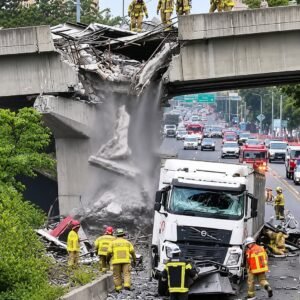
A dramatic image of a damaged overpass, a heavy truck beneath the wreckage and emergency crews responding has raised urgent questions. But what actually happened—and what can be confirmed?
The photograph shows a roadway scene that appears serious: a section of an elevated structure has collapsed or suffered major damage, debris is scattered across the road, a white truck is stopped beneath the damaged area, and emergency personnel are working around the wreckage. The image alone, however, does not establish the location, the time, the cause of the damage, or whether anyone was injured.
That distinction matters. A headline saying “just five minutes ago” creates a sense of immediate danger, but the screenshot does not provide a verifiable timestamp or an official incident report. The article below will therefore stay close to what the image actually shows, explain the questions that a genuine investigation would need to answer, and avoid inventing a city, casualty figures or a cause that the supplied material does not confirm.
What the Image Appears to Show
The supplied photograph appears to capture the aftermath of a serious failure involving an elevated roadway. A section of the concrete structure is broken open, debris has fallen onto the road below, and a large white truck is positioned close to the damaged area. Emergency personnel in high-visibility clothing are visible both above and below the damaged section.
The scene raises several urgent questions. Did the structure fail suddenly? Was the truck involved in the incident, or was it simply passing beneath the overpass? Were people trapped? Had the road been closed before the photograph was taken? And what did investigators discover about the condition of the structure?
The accompanying online article describes a sequence of images showing an apparent elevated-roadway collapse, but it explicitly says the photographs do not establish the exact location, date, cause or number of casualties. It would therefore be irresponsible to report a confirmed death toll, identify a country or blame a driver or construction company based on this material alone.
The most important update at this stage is not a dramatic explanation. It is that the available material does not yet establish the basic facts needed to identify the incident.
A Moment That Could Change an Ordinary Journey Forever
An ordinary journey can become an emergency in a matter of seconds. One moment, vehicles are moving beneath an elevated roadway as they do every day. The next, a section of concrete appears broken, debris falls toward the traffic below, and emergency crews are forced to confront a dangerous scene that may still be changing.
That is the unsettling impression created by the photograph accompanying this breaking-news headline.
A large white truck is visible beneath a damaged elevated structure. Pieces of concrete and other debris surround the vehicle. Above it, the roadway appears severely compromised, with a substantial gap between the remaining sections. Emergency personnel wearing protective equipment are positioned around the scene, apparently assessing the damage and responding to the situation.
The image is dramatic because it captures more than damaged infrastructure. It shows a transportation route that may no longer be safe to use, a vehicle caught close to the apparent failure and responders working in an environment where another movement of concrete could create additional danger.
But the most important questions remain unanswered.
Where was the photograph taken? When did the incident happen? Was the truck directly involved in the event, or was it simply caught beneath the damaged structure? Did anyone become trapped? Were there injuries? And what caused the elevated roadway to break apart?
The headline promises an update from an event that supposedly happened only minutes earlier. Yet the supplied material does not provide an independently confirmed location, date, casualty count or official explanation.
That does not make the photograph unimportant. It makes careful interpretation essential.
The following report examines the visible scene, explains the dangers associated with a possible elevated-roadway collapse, explores how emergency teams approach such situations and considers the questions investigators would need to answer before the public could receive a reliable explanation.
The Scene: A Damaged Overpass Above a Busy Road
The first detail that catches the eye is the damaged section of elevated concrete.
An overpass is designed to carry traffic above another road, railway or public space. Its structural components work together to support the weight of the deck, the vehicles traveling across it and the forces created by everyday use.
When a section appears broken or displaced, the concern extends beyond the visible opening.
The remaining structure may still be carrying substantial weight. Some components could be unstable, and damage that appears limited to one area may have affected connected beams, supports or joints.
In the supplied photograph, the damaged area appears to have exposed internal structural material. Rubble is visible beneath the break, while the remaining portions of the elevated roadway appear to extend over the affected section.
A white heavy vehicle is positioned directly below or close to the damaged area. Its presence immediately raises questions about the sequence of events.
Was the vehicle traveling along the road when the structure failed? Had it stopped because debris blocked the route? Was it involved in a collision? Or did it arrive after the initial failure?
The photograph alone cannot answer those questions.
The emergency personnel visible in the image suggest that a response operation was underway when the photograph was taken. Some responders appear to be positioned above the damaged structure, while others are working near the roadway.
Their protective clothing is important. A damaged overpass can present several hazards simultaneously: falling concrete, exposed reinforcement, unstable components, damaged electrical equipment, traffic movement and dust that reduces visibility.
Even when the initial collapse appears to have stopped, the scene may remain dangerous.
A section that has already fallen can leave neighboring components under unexpected stress. A piece of concrete that appears stable may be supported by another damaged section. Removing debris without understanding the remaining structure could trigger additional movement.
This is why emergency crews cannot simply rush forward and begin moving every piece of rubble.
The first task is to establish a safe working area.
Why the Truck in the Photograph Raises So Many Questions
The white truck is one of the most noticeable objects in the image.
Heavy vehicles are common on major roads, and they frequently travel beneath bridges and elevated highways. Their size and weight make them especially important when engineers examine a structural incident.
However, the presence of a truck near damaged infrastructure does not prove that it caused the damage.
A heavy vehicle could be a victim of a structural failure, a witness to an incident or an unrelated vehicle that entered the scene after the road became blocked.
Investigators would need to establish its position before, during and after the event.
They might examine the vehicle’s physical condition, the surrounding debris, available surveillance recordings and any accounts from people who were present.
If the truck had been moving immediately before the structure failed, investigators would want to know its speed, direction and route. They would also examine whether there was any contact between the vehicle and the structure.
If the truck was stationary, they would need to establish when it stopped and why.
The vehicle’s cargo could also become relevant if there were evidence of an impact or unusual loading conditions. But no conclusion about its weight, cargo or involvement can be drawn from the supplied photograph.
A responsible report must avoid turning a visible vehicle into an accused party.
The same principle applies to drivers, construction companies and infrastructure authorities. Responsibility cannot be assigned simply because a photograph shows a damaged structure and a vehicle nearby.
An investigation would need evidence capable of establishing the sequence of events.
The Emergency Response: Why Every Movement Matters
A major structural failure can require several emergency services to work together.
Firefighters, rescue personnel, police officers, medical teams and structural engineers may all have different responsibilities, but they must coordinate their actions.
The first priority is protecting life.
Police or traffic authorities may close the road beneath and around the damaged structure. The closure helps prevent additional vehicles from entering the danger area and creates space for emergency equipment.
Firefighters and technical rescue teams then assess the visible damage and look for people who may be trapped.
Medical personnel prepare to treat anyone who has been injured. Depending on the location and the severity of the situation, ambulances may be positioned nearby while hospitals are notified that patients could be arriving.
Structural engineers may also be needed to assess whether the remaining parts of the overpass are stable enough for rescue work to continue.
This is particularly important when large concrete components remain suspended.
A rescue worker approaching a damaged vehicle may be exposed to falling debris or movement in the structure above. Even a small shift in a heavy concrete section can create a life-threatening situation.
The work must therefore be planned carefully.
Searching the area
Once the immediate danger has been assessed, rescue teams need to establish whether anyone is trapped.
They may inspect vehicles, spaces beneath concrete slabs and areas where debris has accumulated. Depending on the circumstances, they can use specialized cameras, listening equipment, search dogs or other tools to help locate people.
The search must cover the entire affected area.
A person may have been thrown clear of a vehicle, moved away from the initial impact or become trapped in a location that is not immediately visible.
Responders also need to account for everyone who may have been involved.
This can be difficult when there are multiple vehicles or when witnesses have left the scene before authorities arrive.
Stabilizing the damaged structure
Before heavy debris can be removed, engineers may need to determine how the remaining structure is supported.
Temporary supports can sometimes be installed to reduce movement. Lifting equipment may be used to move concrete sections, but the process requires careful planning.
The removal of one piece of debris can change the forces acting on another.
A slab that appears to be resting securely may actually be held in place by a damaged beam. Moving it without proper stabilization could cause further collapse.
This explains why rescue operations can take longer than people watching from a distance might expect.
Every movement must be considered.
Reaching vehicles beneath the debris
If a vehicle is trapped beneath concrete, responders may need specialized cutting or lifting equipment.
The condition of the vehicle is only one part of the challenge. The surrounding structure may also be unstable, and rescuers must ensure that their work does not cause additional damage.
Medical personnel may be positioned nearby so that injured occupants can receive immediate attention once they are reached.
The objective is to rescue people while protecting the emergency workers themselves.
The photograph shows personnel working close to the damaged overpass, but it does not establish how many people were involved in the response or whether anyone required extraction.
Those details would need confirmation from the agencies responsible for the operation.
The Hidden Dangers After an Overpass Collapse
The most obvious danger is falling concrete.
However, the hazards can continue long after the initial failure.
A damaged structure may contain exposed steel reinforcement, broken electrical equipment, sharp metal fragments and sections of concrete that could shift without warning.
Dust can also create problems. When concrete breaks apart, fine particles may spread through the air and reduce visibility. People close to the scene may experience respiratory irritation, especially if they remain in the affected area.
Traffic creates another danger.
Drivers approaching a sudden obstruction may brake sharply or attempt to change lanes. Other vehicles may not have enough time to react, increasing the possibility of secondary collisions.
Emergency vehicles can also struggle to reach the scene if traffic becomes congested.
This is why road closures and traffic diversions are essential parts of a major infrastructure emergency.
Authorities may close more than the immediately damaged section because engineers need room to inspect the surrounding structure. A neighboring section that looks undamaged from the road may still have been affected by the same forces.
The safest approach is to keep the public away until qualified professionals have assessed the danger.
Could the Structure Have Failed Without Warning?
One of the most troubling questions after any apparent bridge collapse is whether warning signs existed.
People naturally want to know whether the failure was sudden or whether the structure had shown signs of deterioration before the incident.
There is no single explanation for every structural failure.
Elevated roadways are designed to withstand substantial forces, but their condition can change over time. Materials deteriorate, environmental conditions place stress on structures and unexpected events can damage components.
Several possible mechanisms may contribute to structural failure.
None can be identified as the cause of the pictured event from the available material.
Foundation problems
A bridge’s foundation transfers the weight of the structure into the surrounding ground.
If the soil or rock supporting the foundation changes, the structure may experience settlement or movement.
Water can be an important factor. Heavy rainfall, flooding and erosion may remove material around foundations. In waterways, a process known as scour can gradually remove sediment around bridge supports.
If enough supporting material disappears, the foundation may become unstable.
Possible consequences include movement, tilting, cracking and, in severe cases, structural failure.
Corrosion inside reinforced concrete
Many bridges use reinforced concrete, combining concrete with steel reinforcement.
Concrete is effective at resisting compression, while steel helps resist tension. Together, the materials provide structural strength.
However, steel reinforcement can corrode when moisture and harmful substances penetrate the concrete cover.
Road salt and other chloride sources can accelerate this process.
As the steel corrodes, it may expand, causing surrounding concrete to crack or separate. Over time, the affected component may lose part of its ability to carry loads.
The difficulty is that much of this damage can develop inside the concrete, where it is not immediately visible.
Deterioration of concrete
Concrete is durable, but it is not indestructible.
Repeated exposure to water, temperature changes and environmental conditions can gradually affect its surface and internal structure.
Cracks may allow moisture to enter. In colder climates, repeated freezing and thawing can contribute to deterioration.
Some cracks are not signs of serious structural danger. Others may require urgent assessment, especially when they appear near important supports or connections.
Their location, size and development over time are important.
Overloading
Bridges are designed for particular combinations of permanent structural weight and temporary loads.
Permanent weight includes the deck, beams and other fixed components. Temporary loads include vehicles and pedestrians.
If actual loading exceeds what a structure can safely accommodate, additional stress may develop.
However, it would be inaccurate to assume that one heavy truck automatically causes an overpass to collapse.
The outcome depends on the design, condition, load distribution and many other factors.
An investigation would need to establish whether loading played any role in a specific event.
Collision damage
A vehicle striking a bridge support can cause serious damage.
The impact may affect concrete, reinforcement or structural connections. Even if the structure does not collapse immediately, hidden damage may remain.
That is why a bridge affected by a significant collision should be examined by qualified engineers before the area is reopened.
Construction or design problems
Structural failures can sometimes involve errors in design, construction or materials.
Inadequate reinforcement, defective connections, poor-quality concrete or departures from approved construction plans may affect a bridge’s performance.
These possibilities require technical investigation and documentation. They cannot be established by looking at a photograph of the damaged structure.
Extreme weather and natural events
Flooding, earthquakes, landslides and other natural events can place unusual demands on bridges.
Flooding may affect foundations. Earthquakes can create horizontal forces. Landslides may destabilize the ground around supports.
The relevance of each possibility depends on the location and circumstances.
Without a verified location and an official engineering assessment, none of these explanations can responsibly be identified as the cause of the scene in the photograph.
The Investigation: What Authorities Would Need to Establish
Once the immediate emergency response is underway, investigators must begin reconstructing what happened.
The investigation would usually involve several separate questions.
First, they would need to establish the timeline.
When was the structure last known to be functioning normally? When was the first sign of damage reported? When did the failure occur? When did emergency services receive the first call?
These details can help establish whether the structure failed suddenly or whether there were earlier signs of a problem.
Second, investigators would need to identify the exact location.
The road name, structure identification number, construction history and responsible infrastructure authority would all be important.
Third, they would examine the physical evidence.
This could include:
Fractured concrete.
Exposed or damaged steel reinforcement.
Broken beams and connections.
The condition of support columns.
Foundation movement.
Damage to nearby road surfaces.
The position of vehicles.
Debris distribution.
The way concrete and metal components have broken can provide clues about the forces involved.
Investigators may also review construction documents, maintenance records and previous inspection reports.
If the structure had recently been repaired, those records could become particularly important.
Witness accounts and surveillance footage
People who were present may have information about what happened immediately before the failure.
A driver might have noticed an unusual movement. A nearby worker might have heard an impact. A resident could have recorded the first visible damage.
Surveillance cameras and vehicle cameras may provide additional evidence.
However, individual accounts must be assessed carefully. People may have seen different parts of the incident, and the confusion of an emergency can affect memory.
A video can also be misleading if it shows only a few seconds of the event.
Investigators need to combine different forms of evidence rather than rely on a single recording.
The role of engineering experts
Structural engineers may examine the damaged components and determine how the failure developed.
They could use measurements, laboratory testing and computer simulations to assess the forces acting on the structure.
The investigation may need to establish whether the failure began at a support, a beam, a connection or the foundation.
It may also need to determine whether the initial damage caused other components to fail.
This process can take time, especially when the structure is badly damaged and some components cannot be examined until debris has been safely removed.
Why the final explanation may take time
The public often expects an immediate explanation after a dramatic incident.
But an early statement from authorities may contain only basic information: where the incident occurred, which roads are closed and whether emergency crews are responding.
The cause may remain unknown for days, weeks or longer.
A reliable investigation must distinguish between the first visible failure and the underlying reason it occurred.
For example, a support may have broken, but that does not automatically explain why it broke. Investigators may need to determine whether the damage resulted from corrosion, impact, foundation movement, construction defects or another factor.
A responsible report should not turn an early possibility into a final conclusion.
Why the Road Could Remain Closed Even After the Rescue
A major overpass failure can disrupt an entire transportation network.
The affected road may need to remain closed while engineers inspect the remaining structure, remove debris and determine whether neighboring sections are safe.
A road closure is not necessarily evidence that the entire bridge is about to collapse. It may be a precaution while specialists assess the situation.
Traffic may be diverted onto nearby roads, increasing congestion far beyond the immediate scene.
Public transport routes may change. Delivery vehicles may need alternative routes. Emergency vehicles may face longer travel times.
Businesses and workers can also be affected.
A bridge that connects residential areas with commercial districts or industrial zones may be an essential part of daily travel. Losing access to it can disrupt thousands of journeys.
Reopening the road may require several stages:
Securing the site and completing rescue operations.
Removing debris that can be moved safely.
Inspecting the remaining structure.
Determining whether temporary supports are necessary.
Assessing the damage and preparing repair or reconstruction plans.
Confirming that the affected route can safely carry traffic again.
The timetable depends on the extent of the damage.
A relatively limited repair may take less time than rebuilding a major section. If the foundations or main support system are affected, the work may be extensive.
The public needs accurate updates about road closures and alternative routes, especially when the affected road is a major transport connection.
What Drivers Should Do When They See a Damaged Overpass
The photograph is a reminder that drivers should never treat visible structural damage as an ordinary roadside obstruction.
If a person sees concrete falling from an elevated roadway, a support that appears severely damaged or a section of bridge that has visibly shifted, the safest response is to avoid the area.
Drivers should not stop underneath the structure to take photographs.
They should not attempt to move debris or inspect a damaged support.
If a safe alternative route is available, they should use it and report the hazard to the relevant emergency service or transportation authority.
If police or emergency personnel have closed the road, drivers should follow their instructions rather than attempt to pass through the restricted area.
A bridge can contain hidden damage that is not visible from the road. Even if one section appears intact, it may be connected to components that have already been compromised.
Only qualified professionals can assess whether the remaining structure is safe.
What People Should Do During a Sudden Structural Failure
A collapse is an extreme emergency, and there may be very little time to react.
No single action can guarantee safety in every situation, but some general principles are important.
If someone is on foot near a structure that appears to be failing, they should move away immediately and seek an open area outside the potential debris zone.
They should avoid standing beneath adjacent sections of the bridge, even if those areas appear undamaged.
If someone is driving, they should avoid entering the affected area if they can safely turn away before reaching it. Sudden maneuvers should be avoided if they would create another collision.
Anyone who witnesses the incident should contact emergency services once they are in a safe location.
If someone is injured, people nearby should avoid entering an unstable collapse area. Moving heavy debris without proper equipment can cause additional injuries.
Seriously injured people should not be moved unless there is an immediate danger that makes remaining in place more hazardous.
Emergency dispatchers can provide instructions while trained responders are on their way.
The instinct to help is understandable, but rushing into an unstable area can create additional victims.
The Human Cost Behind Infrastructure Damage
A damaged bridge is often discussed in terms of engineering, concrete, steel and repair costs.
But the most important consequences involve people.
A driver may have been traveling to work. A passenger may have been on the way to visit family. A delivery worker may have been completing an ordinary route.
When a structure fails, the people nearby can face sudden danger without having any warning.
Families may wait for information about relatives. People who escape physical injury may still experience emotional distress.
Witnesses may remember the sound of breaking concrete, the cloud of dust and the confusion that followed.
Survivors can also face a long recovery if they suffer fractures, crush injuries or other trauma.
Communities may lose confidence in infrastructure they previously used without thinking.
That is why communication after a major incident matters.
Authorities should provide accurate information when it becomes available, explain road closures and avoid releasing unconfirmed casualty figures.
Families deserve clear communication and privacy.
The public deserves facts rather than speculation.
And people affected by an incident may need support long after the emergency vehicles have left the scene.
The Importance of Regular Bridge Inspections
One of the largest lessons associated with bridge failures is the importance of maintenance.
A bridge can remain in service for decades, but it cannot simply be built and forgotten.
Traffic volumes change. Vehicles become heavier. Weather patterns place different stresses on infrastructure. Water, corrosion and material deterioration can affect structural components.
Regular inspections help identify problems before they become dangerous.
Depending on the structure and local regulations, inspections may include visual examinations, measurements, specialized testing and detailed assessments of important components.
Inspectors may look for:
Cracks in concrete.
Exposed or corroded reinforcement.
Water leakage.
Damaged drainage systems.
Movement near supports.
Deformation of beams.
Damaged expansion joints.
Signs of impact.
Deterioration around foundations.
Not every defect requires a complete closure. Some problems can be addressed through routine maintenance.
Others may require strengthening, traffic restrictions or major reconstruction.
The important point is that serious defects should not be ignored.
Maintenance budgets are sometimes treated as secondary to new construction. But maintaining existing infrastructure is a fundamental part of public safety.
A bridge that is properly inspected and maintained can remain useful for many decades. Age alone does not mean a structure is unsafe.
The real danger is allowing deterioration to progress without appropriate action.
The Economic Impact of a Major Roadway Failure
When an elevated roadway becomes unusable, the consequences can extend far beyond the damaged structure.
A major road may connect residential neighborhoods with workplaces, schools, hospitals and industrial areas.
If it is closed, traffic may need to move onto smaller roads that were not designed to carry the same volume.
Commuters may face longer journeys. Delivery schedules may be disrupted. Businesses may experience delays. Public transport routes may need to change.
Emergency services may also have to adjust their routes.
The financial cost of reconstruction can include debris removal, engineering assessments, temporary traffic arrangements, replacement materials and construction work.
If nearby roads, utilities or rail infrastructure are damaged, additional repairs may be necessary.
However, the economic cost should never overshadow the human consequences.
The purpose of infrastructure is to serve the public. When it fails, the priority must remain the safety and well-being of the people who depend on it.
Why the Phrase “Just Five Minutes Ago” Attracts So Much Attention
The headline accompanying the photograph uses a familiar social-media formula.
The phrase “BREAKING NEWS” suggests an urgent development. The words “Just 5 Minutes Ago” create the impression that the information is extremely recent. The invitation to read more promises that the next section will reveal an important detail.
This format can attract attention because people naturally want to know whether an event affects their community, family or daily routine.
But a dramatic headline is not the same as a verified update.
A photograph can be genuine while its caption is inaccurate. An old image can be shared as though it were new. A picture from one country can be used to illustrate a story from another.
This is why readers should look for the basic details before sharing a breaking-news post.
A reliable report should identify the location, provide a publication time, explain what has been confirmed and distinguish official statements from witness accounts.
If the event is still developing, the report should say which details remain unknown.
The supplied screenshot does not establish the exact time or location of the apparent collapse. The associated article also states that the images do not confirm a casualty count or cause.
That limitation should remain clear.
The photograph may be alarming, but it should not be used to invent a story about people being killed, a truck driver being responsible or authorities ignoring earlier warnings.
The truth matters more than the most dramatic possible explanation.
The Questions That Still Need Answers
Several important questions remain open when the photograph is considered on its own.
Where did the incident occur?
The supplied image does not identify a road, city or country. Without a confirmed location, it is not possible to connect the scene to a particular local authority or official report.
When was the photograph taken?
The headline says “Just 5 Minutes Ago,” but the image does not provide a verifiable timestamp. A social-media caption cannot establish the actual date or time.
What happened to the truck?
The white truck is visible near the damaged section. Its position raises questions, but the photograph does not establish whether it was involved in the initial failure.
Were people trapped?
The image shows emergency personnel, but it does not establish how many people were involved or whether anyone needed to be rescued.
Were there injuries or deaths?
No reliable casualty figures are provided in the supplied material. Any specific number would be speculation.
What caused the damage?
Possible causes of structural failure include impact, deterioration, foundation problems, construction defects and extreme environmental conditions. None can be identified as the confirmed cause here.
Could the structure have been inspected before the incident?
That question would require the structure’s identity, maintenance records and inspection history.
These are not minor details. They are the foundation of a reliable news report.
Until they are established, the most accurate description is that the photograph appears to show a severely damaged elevated roadway with emergency personnel responding.
Final Update: What Can Actually Be Confirmed From the Available Material?
The photograph is alarming.
It appears to show a section of elevated concrete structure that has broken apart above a road. A white truck is positioned close to the damaged area, debris is scattered beneath the structure and emergency personnel are visible around the scene.
The image raises serious questions about structural safety and the risks faced by people traveling beneath elevated roadways.
But the available material does not establish the exact location, date, cause or number of casualties.
It does not confirm that the truck caused the damage. It does not establish that anyone died or was injured. It does not provide an official investigation report.
The most responsible answer to the headline is therefore that the photograph appears to depict a serious infrastructure emergency, but the precise event and its consequences remain unverified from the supplied evidence.
That is why readers should look for a confirmed update rather than rely on the words “just five minutes ago.”
A bridge is more than concrete and steel. It is a connection between homes, workplaces, schools and communities. People depend on these structures every day, often without giving them a second thought.
When an overpass appears to fail, the immediate priority is to protect anyone nearby, secure the affected road and determine whether the remaining structure is safe.
After that comes the difficult work of establishing what happened, why it happened and whether the failure could have been prevented.
Those answers require evidence, engineering expertise and a careful investigation.
Until they are available, the photograph should be treated as a warning about the potential consequences of structural failure—not as proof of an unverified casualty report or a specific cause.
The most important update is not the most dramatic one. It is the one that tells the public what actually happened, where it happened and what is being done to protect people.